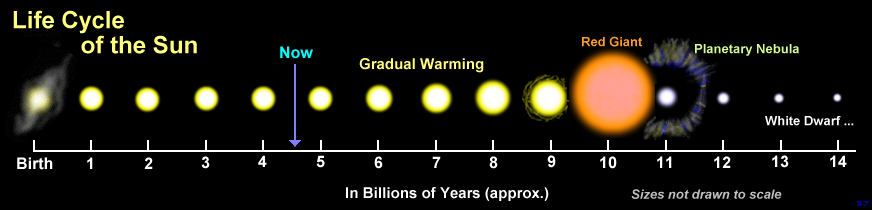
Officially, the sun is classified as a G2 type star based on its temperature and the wavelengths or spectrum of light that it emits. The sun is an "average" star, merely one of billions of stars that orbit the center of our galaxy.The sun has "burned" for more than 4.5 billion years and will continue to do so for several billion more. It is a massive collection of gas, mostly hydrogen and helium. Because it is so massive, it has immense gravity, enough gravitational force to hold all of hydrogen and helium together.The core starts from the center and extends to 25 percent of the sun's radius. Here, gravity pulls all of the mass inward and creates an intense pressure. The pressure is high enough to force atoms of hydrogen to come together in nuclear fusion reactions. Two atoms of hydrogen are combined to create helium-4 and energy in several steps:1. Two protons combine to form a deuterium (hydrogen atom with one neutron), a positron (similar to electron, but with a positive charge) and a neutrino.
2. A proton and a deuterium atom combine to form a helium-3 atom (two protons with one neutron) and a gamma ray.
3. Two helium-3 atoms combine to form a helium-4 (two protons and two neutrons) and two protons.These reactions account for 85 percent of the sun's energy. The remaining 15 percent comes from the following reactions:1. A helium-3 and a helium-4 combine to form a beryllium-7 (four protons and three neutrons) and a gamma ray.
2. A beryllium-7 captures an electron to become lithium-7 (three protons and four neutrons) and a neutrino.
3. The lithium-7 combines with a proton to form two helium-4 atoms.The helium-4 atoms are less massive than the two hydrogen atoms that started the process, so the difference in mass was converted to energy as described by Einstein's theory of relativity (E=mc2). The energy is emitted in various forms of light (ultraviolet light, X-rays, visible light, infrared, microwaves and radio waves). The sun also emits energized particles (neutrinos, protons) that make up the solar wind. This energy strikes Earth, where it warms the planet, drives our weather and provides energy for life. We are not harmed by most of the radiation or solar wind because the Earth's atmosphere protects us.The radiative zone extends 55 percent of the sun's radius from the core. In this zone, the energy from the core is carried outward by photons. As one photon is made, it travels about 1 micron (1 millionth of a meter) before being absorbed by a gas molecule. Upon absorption, the gas molecule is heated and re-emits another photon of the same wavelength. The re-emitted photon travels another micron before being absorbed by another gas molecule and the cycle repeats itself; each interaction between photon and gas molecule takes time. Approximately 1025 absorptions and re-emissions take place in this zone before a photon reaches the surface, so there is a significant time delay between a photon made in the core and one that reaches the surface.The convective zone, which is the final 30 percent of the sun's radius, is dominated by convection currents that carry the energy outward to the surface. These convection currents are rising movements of hot gas next to falling movements of cool gas, much like what you can see if you placed glitter in a simmering pot of water. The convection currents carry photons outward to the surface faster than the radiative transfer that occurs in the core and radiative zone. With so many interactions occurring between photons and gas molecules in the radiative and convection zones, it takes a photon approximately 100,000 to 200,000 years to reach the surface!Above the surface of the sun is its atmosphere, which consists of three parts.The photosphere is the lowest region of the sun's atmosphere and is the region that can be seen from Earth. It is 180-240 miles or 300-400 km wide and has an average temperature of 5,800 degrees Kelvin. It appears bubbly or granulated, much like the surface of a simmering pot of water. The bumps are the upper surfaces of the convection current cells beneath and each granulation can be 600 miles (1,000 km) wide. As we pass up through the photosphere, the temperature drops and the gases, because they are cooler, do not emit as much light energy. Therefore, the outer edge of the photosphere looks dark, an effect called limb darkening that accounts for the clear crisp edge of the sun's surface.The chromosphere lies above the photosphere to about 1,200 miles or 2,000 km. The temperature rises across the chromosphere from 4,500 degrees Kelvin to about 10,000 degrees Kelvin. The chromosphere is thought to be heated by convection within the underlying photosphere. As gases churn in the photosphere, they produce shock waves that heat the surrounding gas and send it piercing through the chromosphere in millions of tiny spikes of hot gas called spicules. Each spicule rises to approximately 3,000 miles or 5,000 km above the photosphere and lasts only a few minutes. Spicules may also follow along magnetic field lines of the sun, which are made by the movements of gases inside the sun.The corona is the final layer of the sun and extends several million miles or kilometers outward from the photosphere. It can be seen best during a solar eclipse and in X-ray images of the sun. The temperature of the corona averages 2 million degrees Kelvin; although no one is sure why the corona is so hot, it is thought to be caused by the sun's magnetism. The corona has bright areas (hot) and dark areas called coronal holes. Coronal holes are relatively cool and are thought to be areas where particles of the solar wind escape.The sun has been shining for about 4.5 billion years. It has enough hydrogen fuel to "burn" for about 10 billion years. The size of the sun is a balance between the outward pressure made by the release of energy from nuclear fusion and the inward pull of gravity. When the core runs out of hydrogen fuel, it will contract under the weight of gravity; however, some hydrogen fusion will occur in the upper layers. As the core contracts, it heats up and this heats the upper layers causing them to expand. As the outer layers expand, the radius of the sun will increase and it will become a red giant. The radius of the red giant sun will be just beyond the Earth's orbit, so the Earth will plunge into the core of the red giant sun and be vaporized. At some point after this, the core will become hot enough to cause the helium to fuse into carbon. When the helium fuel has exhausted, the core will expand and cool. The upper layers will expand and eject material. Finally, the core will cool into a white dwarf and then eventually into a black dwarf. This entire process will take a few billion years.Now how's that for overkill? ;D If you want to know more about solar flares, sunspots, and solar prominences ask (or look it up). Also, for info on where all that gas came from try researching "the big bang" or "cosmology". I assure you, "God" has nothing to do with it. Later.
zorin72680
#21