Replying to #29
There are two targets, not one. If there is only one target, we won't have an issue of simultaneity.
It does make a difference if a man doing the measurement is on the train or off the train. The amount of light sources is not the problem here. One is used, because more light sources do not make the example any simpler.
If you think the example I used is all bollocks just because I am not a physics professor, I am fine with it. I am just a bit surprised that this came out a person who thinks "
if light was traveling from a moving object it would travel at the speed of light plus the the speed of the object."
Below you will find an excerpt of a paper written by Gerald J. Massey. The excerpt describes the example I used.
Gerald J. Massey is Distinguished Service Professor of Philosophy, former Chairman of the Department (1970-77), former member of the Board of Officers of the American Philosophical Association (1975-80), and former Director of the Center for Philosophy of Science (1988-97). Before joining the Department in 1970, he was Professor of Philosophy at Michigan State, where he had taught since 1963. He has been Managing Editor of the journal Philosophy of Science (1963-69), Secretary-Treasurer of the Philosophy of Science Association (1964-70), and has held visiting appointments at the University of Michigan (1967) and Hamilton College (1982). In 1997 he was awarded the Officer's Cross of the Order of Merit of the Federal Republic of Germany (Bundesverdienstkreuz 1. Klasse) by the President of Germany, Dr. Roman Herzog, for his contributions to German-American philosophical cooperation. His principal interests are zoological philosophy, history of philosophy, logic, philosophy & methodology of science, and philosophy of language.
Unlike me, Gerald J. Massey's got a PhD from Princeton. So I hope you would have the ability to understand his words better than mine.
The excerpt:
"Let us consider the following thought experiment associated with the theory of special relativity: Let us assume hypothetically that we are in a glass room which is moving at a high but uniform velocity towards an outside observer. In the exact center of the room is a light bulb which flashes periodically. At the exact moment that we and the room reach the outside observer the light bulb flashes. Is there any difference between what we see and what the observer sees?Einstein's answer to this question was of course "yes". Since the light from the bulb travels away form the bulb at a constant velocity, and since all the walls of the room are equidistant from the light source, it follows that we will see the light strike both the front wall and rear wall at the same instant. However, for the outside observer there is a crucial difference. From his or her viewpoint outside the room, the front wall is moving forward, away from the approaching light. At the same time the rear wall is moving forward to meet it. Thus from the point of view of the outside observer, the light will reach the rear wall before it reaches the front wall. What was simultaneous from our position inside the room will now be distinct. The conclusion we therefore draw is that the same event will appear differently depending upon the observer's frame of reference."Here is the full article in case you think I made all that up:
http://philsci-archive.pitt.edu/archive/00003190/01/9_irvine.pdf
Why do you think that this has nothing to do with the objectivity of scientific knowledge? If the same event will appear differently depending upon the observer's frame of reference, how can the corresponding scientific knowledge still be objective knowledge?

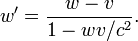 where w' = velocity perceived by observer at point A